


Every family goes through stressful periods. Parents get tired, work becomes demanding, children need more independence as they grow, and no caregiver remains perfectly attentive every day. Uninvolved parenting, however, describes something more persistent than an occasional disconnected moment. Sometimes called neglectful parenting, it involves consistently low emotional responsiveness together with limited guidance, monitoring, and age-appropriate expectations.
Understanding the difference matters. It can help parents recognize patterns that genuinely need attention without turning ordinary exhaustion, work responsibilities, or imperfect parenting into evidence that someone is a “bad parent”.
Quick Answer: Uninvolved parenting is a pattern characterized by low responsiveness and low demandingness. A parent may provide little emotional warmth, guidance, supervision, or structure. This differs from occasionally being tired, distracted, or allowing healthy independence. In more serious situations, chronic failure to meet a child’s physical or emotional needs can overlap with child neglect, but the two concepts should not automatically be treated as identical.
What Is the Uninvolved Parenting Style?
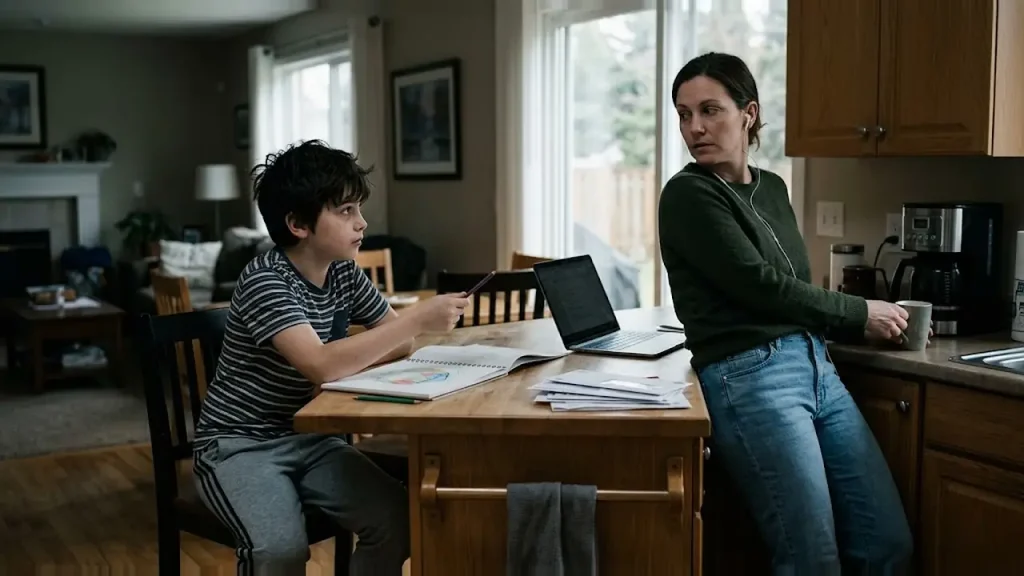
In developmental psychology, the uninvolved parenting style sits at the low-responsiveness, low-demandingness end of a well-known parenting framework. A caregiver following this pattern may show little curiosity about the child’s feelings, friendships, school experiences, or daily concerns. Rules and expectations may be limited or inconsistent, and emotional support may be hard to access when the child is distressed.
Basic physical needs may still be provided. What is often missing is the combination of emotional availability, guidance, monitoring, encouragement, and predictable structure that helps children know both that they are cared for and what is expected of them.
Importantly, parenting styles are broad descriptions of recurring patterns. They are not psychiatric diagnoses, and one difficult week does not determine a parent’s style.
The Four Parenting Styles Framework
Diana Baumrind’s early work identified three broad parenting styles: authoritative, authoritarian, and permissive. In the 1980s, Eleanor Maccoby and John Martin expanded this framework by organizing parenting around two dimensions—responsiveness and demandingness—producing the familiar four-style model that also includes an uninvolved or neglectful category—research on the parenting-styles framework.
| Parenting Style | Responsiveness | Demandingness / Structure |
| Authoritative | High | High |
| Authoritarian | Low | High |
| Permissive / Indulgent | High | Low |
| Uninvolved / Neglectful | Low | Low |
Responsiveness broadly refers to warmth, involvement, sensitivity, and attention to a child’s needs. Demandingness refers to expectations, behavioral guidance, monitoring, boundaries, and age-appropriate responsibility.
Authoritative parenting has frequently been associated with favorable developmental outcomes because it combines warmth with structure. But these categories are not destiny. Outcomes also vary with culture, family circumstances, child temperament, relationships, socioeconomic conditions, and many other influences
Is Uninvolved Parenting the Same as Child Neglect?

Not necessarily. The phrase ‘neglectful parenting’ is often used as another name for the low-responsiveness, low-demandingness parenting style. But child neglect also has a more specific meaning in public health and child protection contexts.
The CDC defines neglect as failure to meet a child’s basic physical and emotional needs, including housing, food, clothing, education, medical care, and appropriate responses to the child’s feelings. CDC definition of child neglect
| Dimension | Uninvolved Parenting Style | Child Neglect |
| Primary Definition | A parenting framework involving low responsiveness and low demandingness. | Failure to meet important physical or emotional needs. |
| Common Manifestation | May involve emotional distance, little monitoring, few rules, or limited guidance. | May involve inadequate food, housing, healthcare, education, supervision, or emotional care. |
| Context & Scope | Describes a recurring relationship pattern. | Considered a form of child maltreatment in public-health frameworks. |
The two can overlap, particularly when a child’s emotional, physical, educational, or safety needs are repeatedly unmet. But they should not automatically be treated as interchangeable, and legal definitions of neglect can vary by jurisdiction.
If a child lacks adequate food, safe shelter, healthcare, supervision, education, or basic safety, the situation should be treated as more than a question about parenting style.
What Uninvolved Parenting Is Not

This distinction is important because articles about parenting styles can easily create unnecessary guilt. Uninvolved parenting is not needing time alone, working long hours, occasionally missing a school activity, letting an older child become more independent, having an exhausting week, or losing patience sometimes. Every parent becomes distracted or emotionally depleted occasionally. The concern is a persistent pattern across time and situations in which emotional engagement, guidance, monitoring, and responsiveness remain consistently limited.
A child becoming more independent because a parent trusts them is also different from a child becoming unusually self-reliant because they have learned that support is generally unavailable.
What Can Contribute to Uninvolved Parenting?

Parental disengagement does not always begin with indifference. Chronic stress, financial strain, illness, inadequate social support, difficult family circumstances, and overwhelming caregiving or work demands can reduce a parent’s capacity to remain emotionally available. Harvard’s Center on the Developing Child similarly notes that financial difficulties, chronic health problems, and lack of social connections can interfere with consistently responsive caregiving.
These pressures can help explain how neglectful parenting patterns develop. They do not make the child’s needs less important. Emotional distance may also occur within a broader dysfunctional family where conflict, disconnection, or unresolved family problems affect how people relate to one another. In some families, one child may require unusually intensive medical, developmental, or emotional support. Parents can understandably become consumed by those urgent needs while another child gradually receives less attention. Our discussion of glass child syndrome explores this particular family dynamic in greater detail.
Understanding the context should lead to support and change—not automatic condemnation and not automatic excuse.
4 Common Signs of Uninvolved Parenting
Any one of these behaviors can happen occasionally in otherwise responsive families. They become more meaningful when several appear repeatedly and form a broader pattern.
1. Limited Emotional Availability and Involvement

The parent shows little interest in the child’s feelings, friendships, worries, accomplishments, or everyday experiences. Conversations may remain largely functional—meals, transport, chores, school logistics—without much emotional connection. When the child is upset, the caregiver may routinely dismiss the feeling, avoid the conversation, or remain emotionally unavailable.
2. Providing Material Needs but Little Emotional Support

A child may have food, clothing, schooling, and other material necessities while receiving very little comfort, affection, encouragement, or guidance. Meeting physical needs is essential, but parenting involves more than financial provision. Children also depend on reliable adults to notice distress, help make sense of difficult experiences, celebrate progress, and offer guidance when life becomes confusing.
3. Other Demands Consistently Crowd Out Connection

Work, social obligations, personal difficulties, digital distractions, or other demands may repeatedly consume the caregiver’s available attention. Having a demanding job does not make someone an uninvolved parent. The concern is the broader pattern: the child rarely experiences meaningful attention or feels able to approach the parent for support.
4. Little Monitoring, Guidance, or Interest in the Child’s Life
There may be few predictable expectations or age-appropriate boundaries. The caregiver may know little about the child’s school performance, friendships, online activity, whereabouts, or challenges. Healthy independence grows alongside age-appropriate guidance. It is different from leaving a child to manage important decisions with virtually no adult support.
How Uninvolved Parenting May Affect Children
No parenting style determines a child’s future. Children differ in temperament, relationships, resources, community support, and resilience. A responsive grandparent, teacher, sibling, coach, therapist, or other caring adult can also become an important source of stability. Still, consistently low warmth and involvement are associated with developmental risks.
1. Emotional and Psychological Difficulties

A systematic review of adolescent research found that greater parental warmth, appropriate behavioral control, and autonomy support were generally associated with fewer internalizing symptoms such as anxiety and depression, although relationships were typically small to moderate and findings varied among studies. A systematic review on parenting styles and adolescent outcomes. This is why the evidence should be interpreted as risk and association, not a prediction that a child raised with an uninvolved caregiver will necessarily develop a mental-health condition.
2. Social and Relationship Difficulties

Children build expectations about relationships partly through repeated interactions with caregivers. When emotional support is consistently unavailable, some children may become reluctant to ask for help, have difficulty trusting that others will respond, or struggle to communicate vulnerability in close relationships.
Others may develop considerable independence. That independence can be a genuine strength while still having developed partly because the child learned to manage problems without dependable adult help.
3. Difficulties With Emotional Regulation
Children gradually learn to handle strong emotions through a combination of maturation, experience, and support from other people. Responsive caregivers can help children identify feelings, calm down, think through problems, and recover after distress. When that support is persistently limited, some children may have more difficulty learning these skills.
Harvard’s developmental work emphasizes the importance of responsive back-and-forth interaction, particularly during early childhood, for developing social and emotional capacities.
4. Parenting Patterns Can Carry Forward—but They Are Not Inevitable

Adults often draw, consciously or unconsciously, on what relationships looked like in their own childhood homes. That can make familiar patterns easier to repeat. But childhood experience does not sentence someone to become the same kind of parent. A pattern can be recognized, questioned, and replaced.
How to Change Uninvolved Parenting Patterns
Recognizing emotional distance can be uncomfortable, particularly when it developed during burnout, grief, financial pressure, illness, or another difficult period. Change does not require becoming a perfect parent overnight. It requires becoming more consistently available.
Harvard describes responsive “serve and return” exchanges as especially important during early childhood: a child communicates through words, sounds, gestures, expressions, or behavior and an attentive adult responds. Harvard University’s Center on the Developing Child, healthy emotional architecture develops through reciprocal, “serve-and-return” interactions between children and caregivers.
With older children and teenagers, responsiveness naturally looks different, but the principle remains useful: notice, listen, respond, and stay engaged.
- Create predictable opportunities for connection. A regular meal, bedtime conversation, drive to school, walk, or daily check-in can create reliable opportunities for a child to talk without forcing intimacy.
- Respond before immediately correcting. When a child is angry, withdrawn, or distressed, try to understand what is happening before moving straight to discipline or solutions. Listening does not require agreeing with every behavior.
- Add age-appropriate structure. Clear expectations, reasonable boundaries, and appropriate monitoring communicate involvement as well as discipline. Our guide to effective parenting explores ways to combine guidance with responsiveness.
- Repair disconnection when it happens. Parents can acknowledge that they missed something important, apologize when appropriate, and show through repeated behavior that they intend to respond differently. Repair does not erase the past, but it can change what happens next.
- Address what is making connection difficult. If burnout, depression, illness, family conflict, financial pressure, or another problem is consistently limiting your ability to care for your child, practical, medical, psychological, family, or community support may be appropriate depending on the cause.
Children do not need flawless parents. They benefit from caregivers who are reliably available enough to notice, respond, guide, set limits, and reconnect after things go wrong.
Final Thoughts
Recognizing uninvolved parenting is not useful if the only result is blame. The more useful question is what happens next. A parent who recognizes a pattern of emotional distance can begin creating more opportunities for connection, stronger boundaries, better monitoring, and more responsive communication. Someone reflecting on their own childhood can also recognize that the way they were parented does not have to determine how every future relationship works.
At the same time, serious neglectful parenting should not be minimized when a child’s basic physical, emotional, educational, medical, or safety needs are going unmet. Parenting patterns are meaningful, but they are not permanent identities. Greater awareness, consistent effort, and appropriate support can create room for a healthier parent-child relationship to develop over time.



Leave a Reply