


The reasons for divorce rarely stem from an isolated argument or a single difficult month. Marriages can unravel through a gradual accumulation of unresolved conflict, emotional withdrawal, financial friction, broken trust, or unaddressed lifestyle differences. In other circumstances, serious concerns may include persistent manipulation, substance misuse, or domestic abuse. In such situations, personal well-being and safety should take priority.
Understanding the common reasons for divorce provides couples with an objective framework to assess their reality honestly. It helps partners recognize recurring problems earlier and identify which challenges they can realistically address. It can also clarify when individual support or separation may be the healthier decision.
Reasons for Divorce vs. Risk Factors
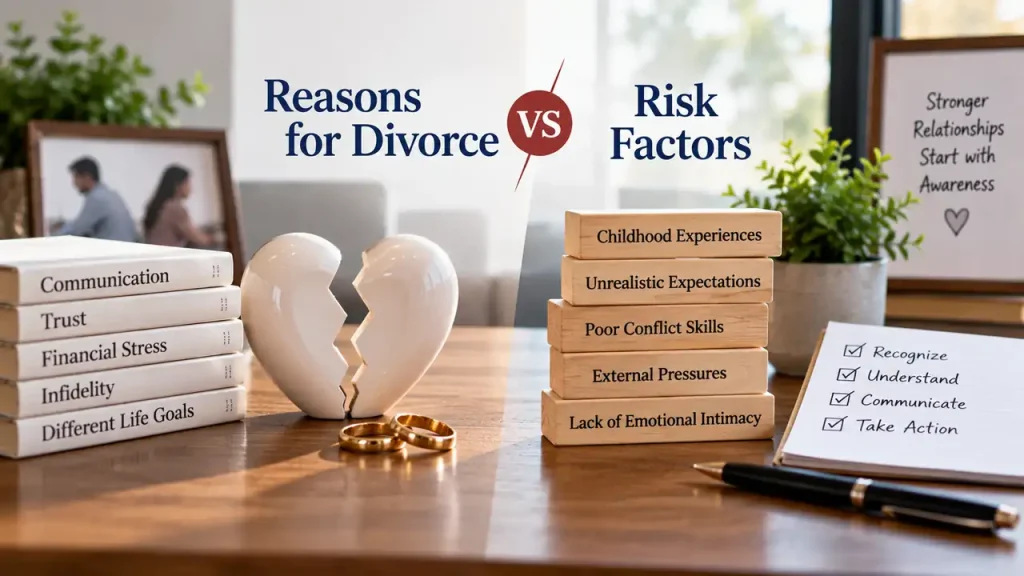
Before examining specific relationship dynamics, it is helpful to understand the distinction between direct reasons and underlying risk factors.
A reported reason for divorce is a problem that partners identify as contributing to the end of their marriage. Examples include chronic hostility, financial secrecy, or infidelity. In contrast, a risk factor is a background or contextual condition associated with greater marital instability. A risk factor may increase strain or vulnerability without being the specific reason a couple identifies for ending the marriage. Risk factors can increase stress within a marriage. However, they are not necessarily the specific reasons for divorce that couples report.
Common Reasons for Divorce

Research on divorce suggests that marital breakdown often reflects longer-term patterns rather than a single event. Instead, dissolution is typically driven by long-standing behavioral and emotional patterns. In one study of 52 divorced individuals who had previously participated in a premarital relationship-education program, lack of commitment, infidelity, and conflict or arguing were the most frequently reported major contributors to divorce.
1. Loss of Commitment
Commitment involves more than simply staying legally married. It also means investing effort, repairing disagreements, and showing up emotionally. In the study cited above, participants most frequently reported lack of commitment as a major contributor to divorce. The marital bond can weaken when one or both partners stop investing emotionally. Avoiding problems or treating the relationship with indifference can create further distance. Over time, when one person continually carries the relational weight while facing unaddressed selfish behavior in marriage, emotional burnout sets in and disengagement follows.
2. Constant Conflict and Poor Communication
Disagreements occur in every partnership, but the manner in which couples navigate conflict matters far more than the frequency of arguments. Research on marital communication suggests that how couples handle disagreements may be more closely related to divorce potential than the particular topics they argue about. Research also links patterns such as withdrawal and negative interaction to poorer relationship quality. Repeated criticism, defensiveness, stonewalling, or other forms of toxic communication in marriage erode mutual respect, leaving both partners feeling alienated and unheard.
3. Infidelity and Breaches of Trust
Extramarital affairs and secret betrayals are deeply destabilising and remain frequently reported contributors to divorce. Infidelity and other serious breaches of trust are frequently reported contributors to divorce. Some couples choose to rebuild the relationship, but doing so generally requires honesty, accountability, consistent behavior, and time. For others, the loss of trust becomes a point from which the relationship does not recover.
4. Financial Conflict and Incompatibility
Financial disagreements rarely involve cash flow alone; opposing values, communication gaps, and security needs often drive the conflict. Research on financial conflict has identified recurring disagreements around relative contributions, income, expenses, financial values, money management, one-sided decisions, and perceived irresponsibility. When partners cannot develop a cooperative financial vision, money disputes become a persistent source of friction.
5. Growing Apart or Loss of Emotional Connection
In a large British survey of recently ended marriages and cohabiting relationships, growing apart was the most commonly reported reason for relationship breakdown.
Over years of juggling demanding work schedules, parenting duties, and personal changes, partners can gradually drift into living like roommates rather than intimate companions. When curiosity, affection, and active appreciation fade, the emotional distance widens. This slow loss of connection leaves partners feeling isolated, even while sharing the same living space.
6. Substance Use or Addiction
Problematic substance use can place significant strain on a marriage through broken trust, financial problems, instability, or repeated unmet commitments. In the divorce study cited earlier, participants commonly reported substance use as a “final straw” reason for ending their marriage. When patterns of dependency remain untreated, the ongoing emotional and practical toll often makes maintaining a healthy, dependable partnership unsustainable.
7. Domestic Abuse or Coercive Control
Domestic abuse fundamentally destroys relationship safety. If a partnership has become an abusive relationship, it cannot be treated as a typical marital disagreement to be resolved through compromise.
Whether taking the form of physical harm, verbal intimidation, emotional manipulation, or subtle coercive control, abuse creates an environment of fear rather than mutual partnership. In situations involving abuse or coercive control, the priority shifts from ordinary relationship repair to personal safety, specialized support, and informed decision-making.
Can Some Causes of Divorce Be Addressed?

Recognizing these destructive patterns does not mean every strained marriage must end. When psychological and physical safety are intact, both individuals recognize the problem, and there is genuine mutual willingness, learning how to save a dying relationship can provide practical avenues for repair before emotional detachment becomes permanent.
The goal is not to preserve a marriage at all costs but to determine whether both partners can build a healthy, mutually supportive dynamic moving forward.
What Couples Can Do When the Marriage Is Struggling

When addressing the common reasons for divorce, theoretical advice is rarely enough. If both individuals are open to repair, these practical approaches offer a structured path forward:
- Communicate About the Actual Problem: Surface arguments about chores or schedules often conceal deeper needs for validation, respect, or affection. Move past defensive reactions, speak honestly about core feelings, and listen without immediately preparing a rebuttal.
- Address Finances Openly: Eliminate financial secrecy by holding regular, low-pressure conversations about budgets, debt, and shared priorities. Establishing complete transparency ensures neither partner feels controlled or excluded.
- Rebuild Trust Where Both Want To: If trust has been broken, words alone will not restore it. The partner who caused harm must offer dependable consistency, verified actions, and patient accountability. Both must also accept that rebuilding trust is a slow, gradual process.
- Balance Individual and Shared Needs: A thriving relationship does not require sacrificing personal autonomy. Sustainable partnerships respect individual interests and friendships while maintaining active investment in mutual family responsibilities and relationship goals.
- Consider Professional Help Where Appropriate: Circular, entrenched patterns are difficult to dismantle alone. A qualified couples therapist may help partners identify recurring patterns, address conflict cycles, and develop healthier ways of communicating when both individuals feel safe participating. Exploring marriage counseling can offer structured guidance, provided both partners are genuinely committed to non-defensive dialogue and mutual effort.
- Prioritize Safety Where Abuse Exists: If a relationship involves violence, threats, intimidation, or coercive control, ordinary relationship repair advice does not apply. Preserving the marriage must not supersede personal safety; reach out to local crisis resources, trusted professionals, or legal counsel to plan a safe transition.
Frequently Asked Questions About Reasons for Divorce
1. What are the most common reasons for divorce?
Commonly reported reasons include lack of commitment, repeated conflict, infidelity, financial disagreements, growing apart, substance-use problems, and, in some cases, abuse or coercive control. The exact reasons for divorce vary from couple to couple, and more than one issue may contribute to the breakdown of a marriage.
2. Is poor communication one of the main reasons for divorce?
Poor communication can contribute to ongoing conflict, emotional distance, and unresolved problems. However, communication problems are often part of a larger pattern rather than the only reason a marriage ends.
3. Can financial problems lead to divorce?
Yes. Financial conflict can place significant strain on a marriage, especially when couples disagree about spending, debt, saving, financial priorities, or transparency. The issue is not always low income itself, but how partners manage money and make financial decisions together.
4. Can a marriage recover after infidelity?
Some couples choose to remain together and work toward rebuilding trust after infidelity, but rebuilding trust usually requires accountability, honesty, consistent behavioral change, and mutual willingness to repair the relationship. Reconciliation is not always possible or appropriate for every couple.
5. Should couples always try to avoid divorce?
No. Some relationship problems can improve with communication, changed behavior, and professional support, but a marriage should not be preserved at any cost. If there is violence, coercive control, intimidation, or fear, safety should take priority over attempts to save the relationship.
Final Thoughts
Understanding the reasons for divorce shows why the end of a marriage is rarely explained by a single problem. Conflict, loss of trust, financial disagreements, emotional distance, and other difficulties can overlap and intensify over time. Identifying these common reasons for divorce gives couples an objective reference to evaluate their relationship realistically rather than reacting in panic.
The essential question for couples is not simply how to avoid divorce at all costs, but whether the relationship can realistically become safe, respectful, and sustainable for both individuals. Where genuine commitment and mutual goodwill exist, meaningful repair remains possible. Where basic respect, safety, or shared effort cannot be re-established, separation may ultimately be the healthier decision.


Interesting facts though, Ana, it is a good overview, but sometimes despite of all your efforts some relationship doesn't work, so it's better to let go!
Right Jenny, I agree with you somethings when the odds are at your end, you are failed to do anything. However, doing your best to avoid divorce is what one can still do if it comes to family. – Ana